Milestone: Subcutaneous siRNA Crosses the Blood–Brain Barrier, Alzheimer's Candidate Shows Striking Tau Reduction
Arrowhead's ARO-MAPT lowered cerebrospinal-fluid Tau by up to 73% on average (85% max in an individual) in healthy volunteers via subcutaneous injection, crossing the BBB through TfR1 antibody-Fab conjugation. Advances in fat, muscle and lung extrahepatic delivery are expanding the siRNA landscape.
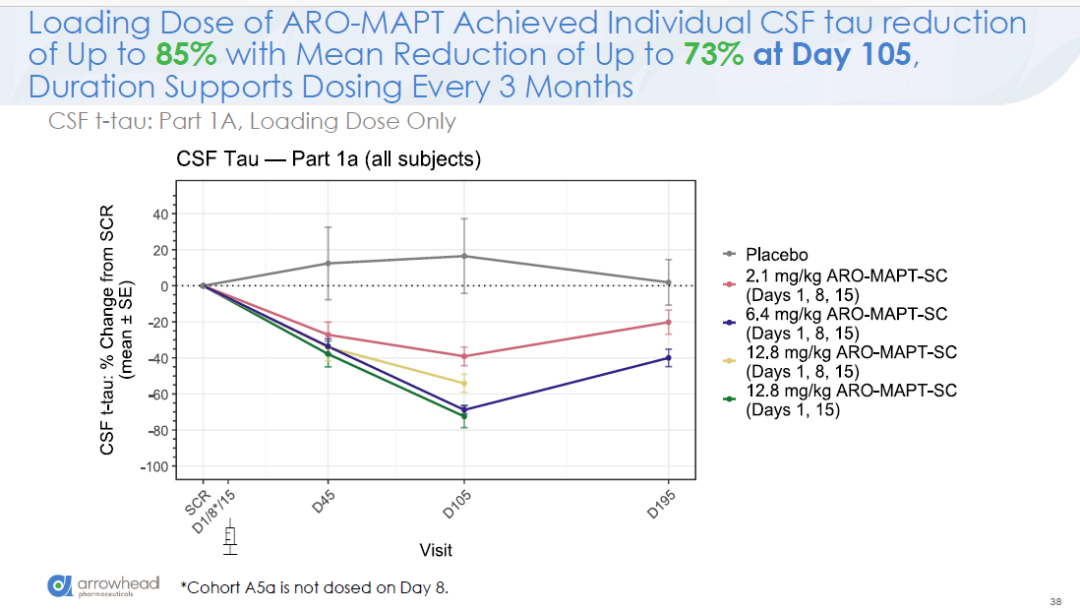
"Congratulations to the Arrowhead team! This is a major milestone for the field." So commented John Maraganore, Alnylam's founding CEO, on social media. That day Arrowhead Pharmaceuticals reported that its siRNA therapy ARO-MAPT, given subcutaneously, reduced cerebrospinal-fluid Tau by up to 73% on average (85% max in an individual) at day 105 in healthy volunteers — providing key human evidence that subcutaneous siRNA can cross the blood–brain barrier and hit a central-nervous-system target.
Subcutaneous delivery crosses the blood–brain barrier
For Alzheimer's disease, the blood–brain barrier is a formidable gate: it protects the CNS but makes drug delivery exceptionally difficult. siRNA can selectively degrade disease-related mRNA via RNA interference, yet the molecules struggle to cross cell membranes and the BBB, often requiring invasive intrathecal injection. In 2023, Alnylam and Regeneron's ALN-APP achieved up to 90% reduction in CSF biomarkers by intrathecal delivery (C16 lipid conjugation). Arrowhead's advance offers a new path via subcutaneous injection.

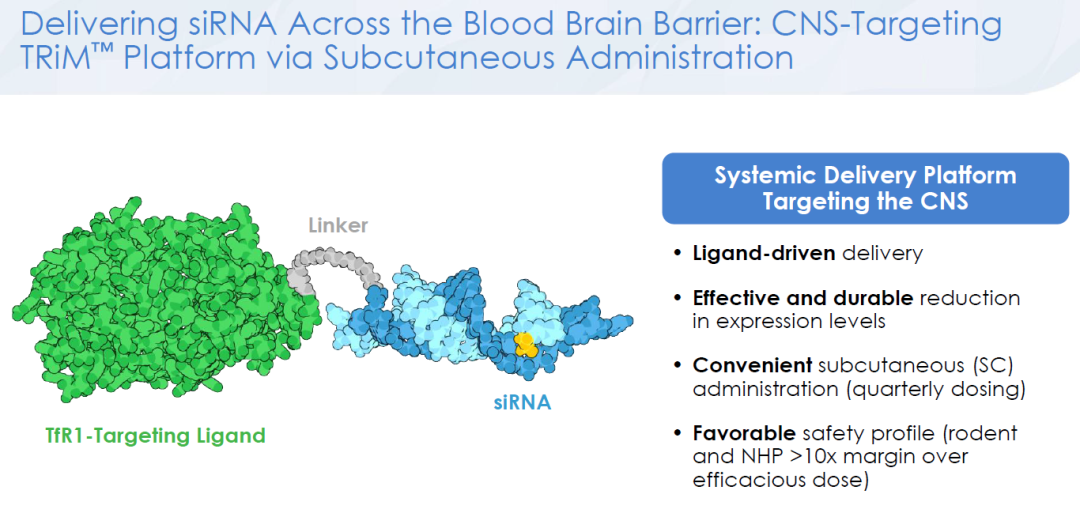
ARO-MAPT uses Arrowhead's Targeted RNAi Molecule (TRiM) platform, conjugating the siRNA to an antibody Fab fragment targeting transferrin receptor 1 (TfR1) to cross the BBB via receptor-mediated transport. TfR1 is highly expressed on BBB endothelial cells; the Fab binds TfR1 and helps the conjugated siRNA traverse the barrier and reach target cells in brain tissue, potentially solving the long-standing challenge of systemic siRNA reaching the CNS.
Deep and durable Tau knockdown
ARO-MAPT reduces Tau production by degrading MAPT mRNA, potentially slowing related neurodegenerative disease. In the reported Phase 1/2a study: at 12.8 mg/kg, mean CSF total Tau fell 73% (85% max individual) at day 105; at 2.1 and 6.4 mg/kg, mean reductions were 40% and 69% respectively; 90 days after the last dose, Tau remained markedly lowered, suggesting dosing every three months or longer may be possible. In healthy volunteers, ARO-MAPT was generally well tolerated with no serious treatment-emergent adverse events. The study remains early — these are primarily healthy-volunteer biomarker results and cannot yet indicate cognitive benefit — and Arrowhead is advancing an early Alzheimer's patient cohort, with further data expected in 2027.
Beyond the brain: extrahepatic siRNA delivery accelerates
ARO-MAPT exemplifies the evolution of siRNA delivery. GalNAc conjugation established hepatic targeting; since 2026, fat (ARO-ALK7 dual-lipid conjugation, 88% mean ALK7 mRNA reduction in adipose at week 8), muscle (Novartis del-brax, a TfR1 antibody–siRNA conjugate, hit biomarker endpoints in FSHD), and lung (ARO-RAGE, a trispecific small-molecule ligand for inhaled delivery, 90.2% max soluble-RAGE reduction) have all reported clinical progress. The trend is clear: no single universal delivery strategy fits all tissues — each requires tailored ligands, linkers and conjugation designs based on its biology.